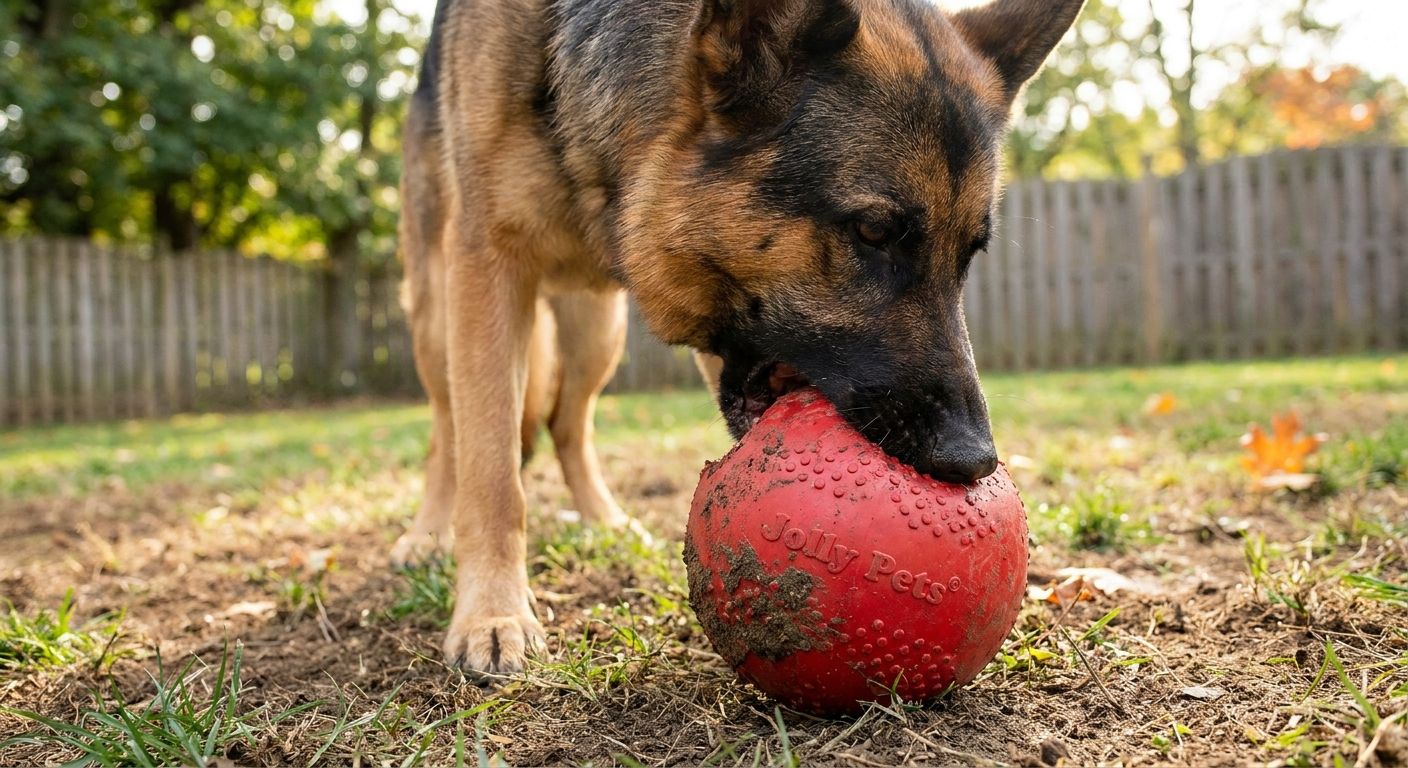
The Jolly Pets Jolly Ball looks like a plain hard-rubber sphere, but for a dog that can crack a KONG in a week, plain is exactly what needs testing. This guide breaks down whether the Jolly Pets Jolly Ball for aggressive chewers actually holds up, which size fits which jaw, and what to grab instead if it doesn't.
- Jolly Pets Jolly Ball for aggressive chewers holds up on dogs under 60 lbs with moderate bite force — Consider, not an automatic Buy for max-force chewers.
- The 8-inch size resists jaw leverage; smaller diameters crack under sustained pressure from power chewers — size up or skip entirely.
- KONG Extreme Ball beats the Jolly Ball on raw bite resistance for true aggressive chewers in 2026 — Buy if your dog has already destroyed two or more balls this year.
- KONG Wunderball costs less but wears faster under heavy chewing — Hold it for fetch rotation, not solo chew sessions.
Why This Matters
A cracked hard-rubber ball isn't just a wasted $10 to $15. Sharp edges from a split Jolly Ball can cut gums, and swallowed chunks send dogs to the emergency vet more often than owners think. Blue, the rescued pit bull that gets tested on every review at Cordova's Corner, has gone through his share of "indestructible" balls that weren't — that history is exactly why size and wall thickness matter more than the marketing copy on the package.
The Jolly Pets Jolly Ball for aggressive chewers keeps showing up in searches next to the best indestructible balls for power chewers, and the honest answer is: it depends heavily on size and how hard your dog actually bites, not just breed.
Who This Guide Is For
This is for owners of pit bulls, mastiffs, cane corsos, and other jaw-strong breeds who've already gone through two or three "tough" balls this year. If your dog treats tennis balls as a five-minute snack and shreds squeaky toys on sight, you're the target reader. This guide is not for puppies or light chewers — for them, almost any ball on the market survives, and spending up on a heavy-duty option is wasted money.
What to Look for in a Jolly Ball for Aggressive Chewers
Wall thickness and rubber hardness
The Jolly Pets Jolly Ball is molded from a single dense rubber shell with no seams, which matters because seams are the first failure point on cheaper balls. A thicker wall resists puncture from carnassial teeth — the back molars dogs use to crack things open — longer than a thin-walled ball built for fetch alone.
Ball diameter versus mouth size
A ball small enough to wedge past the molars becomes a choking hazard the moment a corner chips off. Jolly Pets sells the Jolly Ball in roughly 4.5-inch, 6-inch, 8-inch, and 10-inch diameters — for a 50-to-80-pound power chewer, the 8-inch size is the realistic starting point, not the smaller sizes made for younger or smaller dogs.
Bounce and buoyancy
If fetch or pool time is part of the routine, buoyancy matters as much as bite resistance. The Jolly Ball floats, which is a genuine advantage over some hard rubber balls that sink and get lost or abandoned at the bottom of a pond.
Scent grooves and wear pattern
Some Jolly Ball versions have raised nubs or a vanilla scent baked into the rubber. Nubs are the first thing to wear smooth or shear off under heavy chewing — check for flattened nubs during weekly toy inspections, since that's an early warning sign before a crack forms.
Price versus replacement frequency
A Jolly Ball runs cheaper than most premium chew balls, but if an aggressive chewer cracks it every three weeks, the real cost adds up fast. Compare cost per month of actual use, not sticker price, before deciding it's a bargain.
No handle, no rope attachment
Unlike tug-style chew balls, the standard Jolly Ball has no handle or rope loop. That's a feature for chewers who destroy anything with an attachment point first — fewer parts means fewer places for teeth to find a weak seam.
Top Picks for Aggressive Chewers
Jolly Pets Jolly Ball (8-inch) — the safe pick. This is the size Cordova's Corner recommends starting with for any dog over 50 pounds with a documented history of destroying toys. The larger diameter keeps it out of full molar range and the single-piece rubber shell has no seam to split first. Verdict: Consider — solid for moderate-to-strong chewers, but not guaranteed against a dog that has already cracked a KONG Extreme.
Jolly Pets Jolly Ball (10-inch) — the wildcard for XL dogs. Mastiffs, cane corsos, and other 90-pound-plus breeds need the bigger diameter just to keep the ball manageable in the mouth. It's harder to find in stores and costs more, but it buys real margin against choking risk for genuinely large-jawed dogs. Verdict: Consider for XL breeds specifically, Skip for anything under 70 pounds — it's overkill and less fun to fetch.
KONG Extreme Ball — the backup pick if the Jolly Ball fails. The KONG Extreme Ball for aggressive chewers uses KONG's black extreme-rubber compound, built specifically for dogs already flagged as destructive chewers. If your dog has cracked two or more standard balls in the past year, this is the toy that should replace the Jolly Ball in rotation, not sit next to it. Verdict: Buy for confirmed power chewers.
KONG Jumbler Ball — the fetch-and-chew combo. This one pairs a tennis-ball-style outer shell around a rubber core, aimed at dogs who want to chew and fetch the same toy. It doesn't match the Jolly Ball's pure bite resistance, but it covers a gap the Jolly Ball doesn't: interactive play with a squeak. Verdict: Consider as a second toy, not a replacement for heavy chewing sessions.
KONG Wunderball — the budget pick. The KONG Wunderball for power chewers costs less than most premium balls and bounces unpredictably, which is great for fetch but not built for sustained gnawing. Rotate it in for play, not as the toy left alone with an aggressive chewer. Verdict: Hold for fetch rotation, Skip as a solo chew toy for max-force dogs.
“If a chew toy can't survive fifteen minutes alone with a power chewer, it's not a chew toy — it's a snack.”
What to Avoid
- Smaller Jolly Ball sizes for large dogs. The 4.5-inch and 6-inch versions are made for small-to-medium dogs, not for a 70-pound pit bull with full adult teeth — the smaller diameter puts it well within crushing range of the molars.
- Any ball with a squeaker for known destroyers. Squeaker mechanisms are the first thing an aggressive chewer targets, and the plastic bladder inside becomes a swallow risk once exposed.
- Buying one ball and expecting it to last the year. Even the toughest hard-rubber balls need weekly inspection for cracks, flattened nubs, or exposed edges — replace at the first sign of damage rather than waiting for a full break.
Verdict Comparison
| Toy | Best Diameter for Power Chewers | Bite Resistance | Verdict |
|---|---|---|---|
| Jolly Pets Jolly Ball | 8-inch | Moderate-high | Consider |
| Jolly Pets Jolly Ball (XL) | 10-inch | Moderate-high | Consider (XL breeds only) |
| KONG Extreme Ball | — | High | Buy |
| KONG Jumbler Ball | — | Moderate | Consider (secondary toy) |
| KONG Wunderball | — | Low-moderate | Hold |
FAQ
Is the Jolly Pets Jolly Ball good for aggressive chewers?
The Jolly Pets Jolly Ball works for moderate-to-strong chewers under about 80 pounds when sized at 8 inches or larger. Dogs that have already cracked a KONG Extreme Ball need a tougher option first.
What size Jolly Ball should I buy for a pit bull?
An 8-inch Jolly Ball is the realistic starting size for most adult pit bulls in the 50-to-80-pound range. Go up to the 10-inch size for mastiffs or other XL breeds with wider jaws.
Is the Jolly Ball better than a KONG Extreme Ball?
No, the KONG Extreme Ball has higher raw bite resistance and is built specifically for confirmed destructive chewers. The Jolly Ball is a fine daily option, but the KONG Extreme is the safer bet once a dog has proven it can crack standard balls.
Does the Jolly Ball float in water?
Yes, the Jolly Ball is buoyant and floats, which makes it a solid fetch toy for pool or lake time. That buoyancy is one of its real advantages over denser rubber balls that sink.
How often should I replace a Jolly Ball for a power chewer?
Check it weekly for cracks, flattened nubs, or exposed edges and replace at the first sign of damage. Aggressive chewers can wear through a ball faster than the packaging timeline suggests.
Can puppies use the Jolly Ball for aggressive chewers?
Puppies generally don't need the heavy-duty sizing, since their bite force is far lower than an adult power chewer's. A smaller, softer chew is usually a better fit until adult teeth and jaw strength come in.
Is the Jolly Ball safe if it cracks?
No — a cracked hard-rubber ball can expose sharp edges or break into swallowable chunks. Remove it immediately and replace with an intact toy rather than letting the dog keep working the crack.
One Last Thing
The detail most owners miss: the Jolly Ball's single-piece, seamless construction is its biggest advantage over cheaper hard-rubber balls, but it also means there's no way to "repair" a crack once it starts — unlike some layered chew toys, once the shell splits, replacement is the only safe option. Keep a second toy in rotation so a cracked Jolly Ball never means a bored, chew-hungry dog with nothing safe to bite.