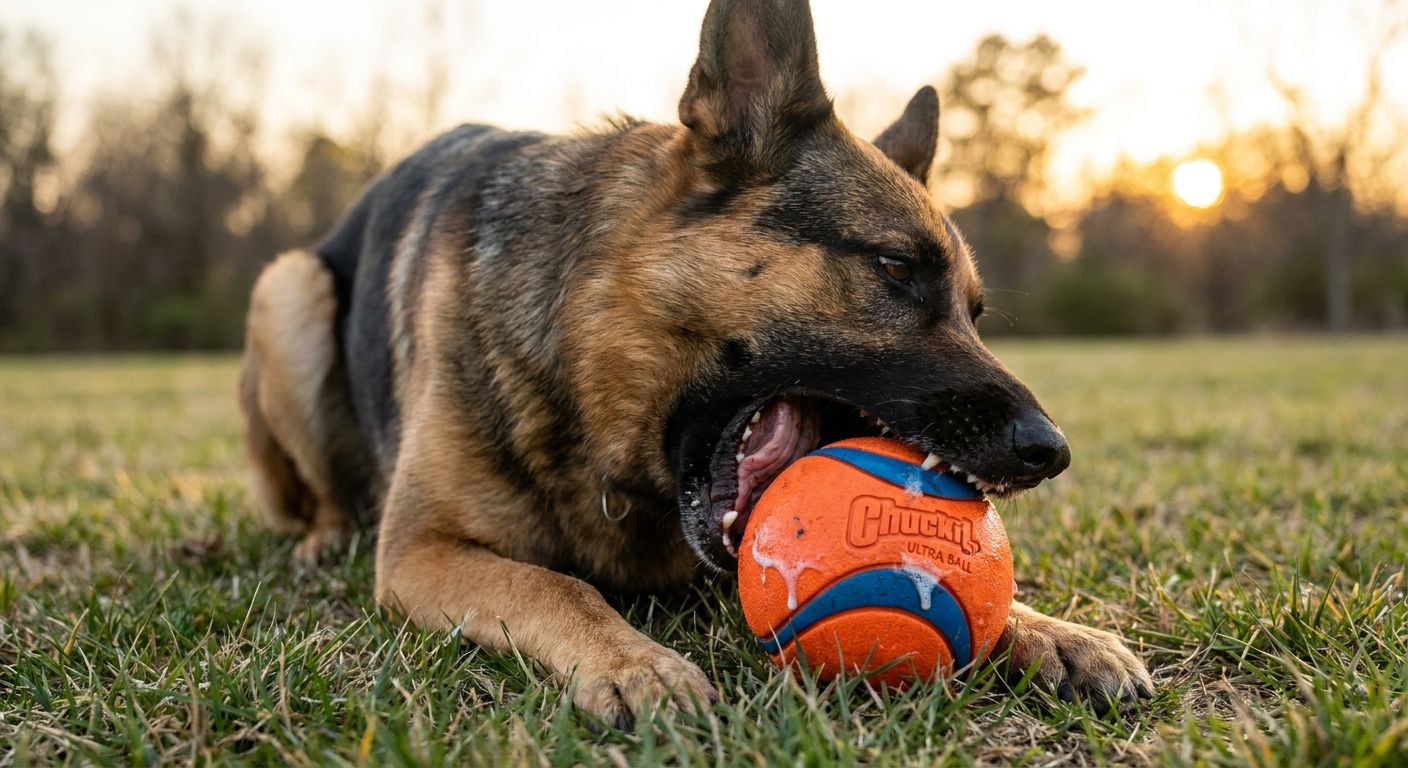
Blue goes through fetch balls the way most dogs go through treats — fast, loud, and with zero regard for the manufacturer's marketing copy. The Chuckit Ultra Ball gets asked about constantly by pit bull and power-chewer owners, so here's the straight answer on where it fits and where it doesn't.
- Chuckit Ultra Ball for power chewers works best as a fetch tool, not a solo chew toy — Buy for yard time, Consider for unsupervised chewing.
- Four sizes (roughly 2 to 4.5 inches) mean sizing to your dog's mouth matters more than brand loyalty.
- KONG Extreme Ball and KONG Wunderball both outlast the Ultra Ball under sustained bite pressure — Buy as backups.
- Solid rubber wins over hollow rubber for power chewers every time in 2026 testing conversations with other owners.
Why this matters
A fetch ball that splits after three throws isn't cheap in the long run — it's a repeat purchase every few weeks, and a choking hazard once it cracks. Power chewers don't just carry a ball, they clamp, shred, and sometimes swallow chunks of exposed rubber. Picking the right ball for a strong-jawed dog in 2026 isn't about brand names — it's about bite pressure, size match, and what happens once the surface gets torn.
Who this is for
This guide is for pit bull owners, mixed power-chewer owners, and anyone whose dog treats a standard tennis ball like a chew toy instead of a fetch toy. If your dog retrieves a ball a handful of times and drops it, almost anything works. If your dog clamps down, grinds, or tries to puncture the ball on the way back to you, the Chuckit Ultra Ball needs a second look before you commit to a four-pack. For a wider comparison of what actually survives that kind of pressure, the best indestructible balls for power chewers roundup is worth reading alongside this one.
What to look for in a fetch ball for power chewers
Solid rubber over hollow rubber
A hollow ball collapses the second a strong jaw applies real pressure, and once it collapses it doesn't bounce back — literally or figuratively. Solid rubber balls resist the crush-and-puncture pattern that power chewers default to, which is the main reason the Chuckit Ultra Ball holds up better than dollar-store tennis balls.
Size matched to bite force, not just breed
The Chuckit Ultra Ball comes in four sizes — Small at roughly 2 inches, Medium around 2.5 inches, Large near 3 inches, and X-Large closer to 4.5 inches. A pit bull with a wide jaw and strong bite can get full tooth contact on a ball sized for a smaller dog, which speeds up wear dramatically. Sizing up, not just sizing to breed averages, matters here.
Bounce and float behavior
A ball that floats and bounces predictably keeps fetch sessions actually fun instead of turning into a hunt through the yard. This matters less for durability and more for whether the toy gets used enough to justify buying it — a toy sitting in a drawer isn't saving anyone money.
What happens after the surface tears
Every rubber ball eventually shows tooth marks. The real test is whether small chunks come off cleanly or the whole surface starts flaking into pieces small enough to swallow. This is where owners need to inspect regularly instead of assuming a tough label means indefinite use.
Supervision requirement
No fetch ball, including the Chuckit Ultra Ball, is built to be left with a dog unsupervised for hours. Fetch balls are throw-and-retrieve tools first — that distinction gets lost in a lot of marketing copy.
Top picks for power chewers
The Chuckit Ultra Ball — the fetch workhorse
The spec that matters: solid rubber construction across all four sizes, with the X-Large built for dogs that would flatten a standard tennis ball in one bite. It bounces high and floats, which keeps yard and lake sessions moving. For a dog that fetches and drops rather than settles in to chew, this holds up through regular 2026 backyard use.
Verdict: Buy — for active fetch sessions with supervision, not as an unsupervised chew toy.
KONG Extreme Ball — the backup heavyweight
The spec that matters: denser rubber compound aimed specifically at aggressive chewers, which gives it an edge once a dog starts treating the ball like a chew toy between throws. Owners who rotate two balls report the KONG Extreme Ball for aggressive chewers lasting through more clamp-and-hold sessions than standard fetch balls.
Verdict: Buy — the stronger pick if your dog chews the ball as much as it fetches it.
KONG Wunderball — the fetch specialist
The spec that matters: a design built around consistent, predictable bounce for launcher use, which matters if fetch is the primary activity rather than solo chewing. The KONG Wunderball for power chewers trades some chew-resistance for retrieve performance.
Verdict: Consider — strong pick if fetch, not chewing, is the actual use case.
KONG Jumbler Ball — the multi-dog wildcard
The spec that matters: a tennis-ball shell wrapped around a rubber core, giving two textures a power chewer can work through before reaching anything solid. This makes it a longer-lasting option for households running more than one strong chewer at once, since interest tends to split between dogs.
Verdict: Consider — good for multi-dog households, less ideal as a single dog's primary ball.
What to avoid
- Cheap multi-packs of hollow tennis-style balls — they look identical to durable options in photos but collapse in one or two hard bites.
- Any ball smaller than your dog's mouth is wide — a ball that fits too easily inside the jaw gets full crushing leverage, which speeds up damage and raises choking risk.
- Balls with the felt or fuzz coating for dogs that shred fabric — the outer layer comes off in strands that get swallowed before the rubber core even shows wear.
Comparison at a glance
| Toy | Size range | Best for | Floats | Verdict |
|---|---|---|---|---|
| Chuckit Ultra Ball | ~2 to 4.5 in | Active fetch sessions | Yes | Buy |
| KONG Extreme Ball | Multiple sizes | Chew-and-fetch dogs | Yes | Buy |
| KONG Wunderball | Multiple sizes | Launcher-focused fetch | Yes | Consider |
| KONG Jumbler Ball | Multiple sizes | Multi-dog households | Yes | Consider |
FAQ
Is the Chuckit Ultra Ball good for power chewers?
The Chuckit Ultra Ball works well for power chewers as a fetch toy under supervision in 2026, but it isn't built as a standalone unsupervised chew toy. Dogs that mostly retrieve and drop the ball see the best results.
What size Chuckit Ultra Ball should a pit bull use?
Most pit bulls do better with the Large or X-Large Chuckit Ultra Ball, roughly 3 to 4.5 inches, since a smaller ball gives full jaw leverage and wears out faster. Sizing up reduces how quickly the surface breaks down.
Is the Chuckit Ultra Ball better than the KONG Extreme Ball?
The KONG Extreme Ball generally holds up better under sustained chewing, while the Chuckit Ultra Ball performs better for pure fetch and bounce. Owners with dogs that chew between throws often keep both in rotation.
Can the Chuckit Ultra Ball be left with a dog unsupervised?
No fetch ball, including the Chuckit Ultra Ball, is meant for extended unsupervised use with a power chewer. Check the ball for tooth punctures or flaking after every session and retire it once chunks start coming loose.
Does the Chuckit Ultra Ball float?
Yes, the Chuckit Ultra Ball is designed to float, which makes it usable for lake and pool fetch sessions in addition to yard play.
How many sizes does the Chuckit Ultra Ball come in?
The Chuckit Ultra Ball comes in four sizes, running from roughly 2 inches up to about 4.5 inches across. Matching the size to your dog's mouth width matters more than matching it to general breed size.
What's a good alternative to the Chuckit Ultra Ball for aggressive chewers?
The KONG Extreme Ball and the KONG Jumbler Ball are common alternatives for dogs that chew as much as they fetch. Both trade some bounce performance for added chew resistance.
One last thing
The detail most owners miss: rotating two different balls, not buying two of the same one, is what actually extends how long fetch time stays interesting for a strong chewer. A dog that's bored of one texture will grind harder on it out of frustration, which speeds up the exact wear pattern you're trying to avoid.